Evan Favreau
All the Old KnivesEvan Favreau is Celia Favreau’s young son, first presented through small domestic exchanges and his mother’s care, then seen again in the aftermath of the Flight 127 massacre. His brief appearances set a child’s everyday wants and distractions against the helplessness of a mother who can promise protection but cannot save him.
Family Life and Everyday Behavior
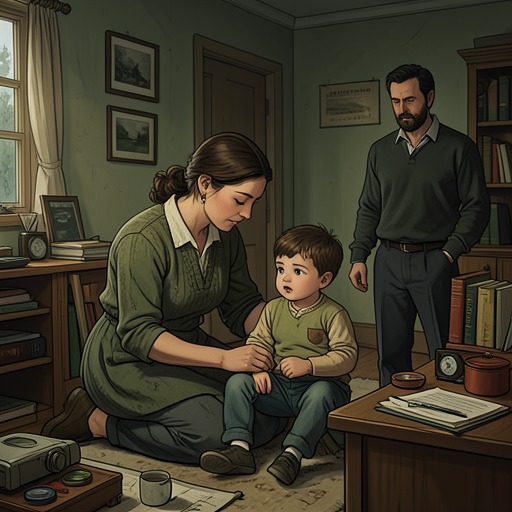
At home, Evan appears at breakfast with Celia and his younger sister, Ginny Favreau. Looking at a screen, he asks, “Mom?” and then, “Can I have Nutella?” His request sits amid the ordinary work of feeding two children: Celia serves eggs, gives him the big-boy fork he has been demanding, and uses a little-kid spoon to feed Ginny.
Evan is absorbed in a game involving birds and pigs. When Celia takes away his iPod and says, “Breakfast first,” he groans; afterward, he carries the game into the living room. Celia puts Ginny in the playpen beside the sofa and asks him to keep an eye on her. He gives a grunt of assent but remains fixed on the game. The scene gives him the limited attentiveness of a child absorbed in play, while also showing Celia beginning to entrust him with a small responsibility toward his sister.
The Hijacking and His Mother’s Protection
During the hijacking, Evan is present when a hijacker shoots a stewardess in the chest. He asks what has happened in a terrified voice, and Ginny begins to cry in Celia’s lap. Celia turns from the violence to her children, draws their faces close, and instructs them to remain seated and quiet because a dangerous man is on the plane. Evan and Ginny cling to her, and she squeezes them close, trying to make her embrace a place of safety.
Celia tells them that she will not let anything happen to them. The promise conveys the force of her maternal instinct, but the later account of the aircraft’s dead gives it a tragic limit: she can guide the children through the immediate danger, yet cannot protect them from the catastrophe that follows.
Death and Narrative Significance
In a later recollection of the aircraft after the mass deaths, Celia sees children in the forward cabin, their faces pale and blood visible at their noses. She runs down the aisle, counting rows, and nearly trips over Evan’s sneaker at row 22. He is on the floor, his foot still inside the shoe; he had slipped from his seat during his death tremors. Ginny lies curled in the seat above him in a dark puddle. The precise discovery turns the earlier domestic scenes into memories of lives abruptly cut short.
Evan’s appearances are brief, but their contrast is central to their effect. At home he asks for a sweet spread, resists leaving his game, and is only half-attentive when asked to watch Ginny. On the plane, his mother’s instructions and embrace are set against a danger no child can understand or evade. His death is not given an independent account; it enters through Celia’s horrified recognition, making the loss inseparable from her memory of the aircraft and from the limits of the reassurance she once gave him.